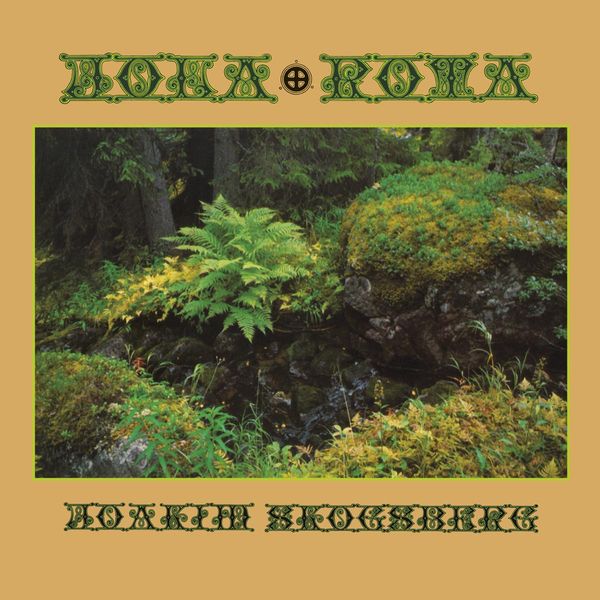
Jola Från Ingbo Offer Rota Frirdens Liljo B: Besvärjelsens Rota Jola Från Stensäte Jola Från Leksand
Joakim immerses himself in the
Swedish landscape and draws heavily on traditional jolor vocalising, creating a wyrd gem, an infusion of low-key fuzzed up violins, rattling hand percussion, droning vocals and pulsating bass rhythms. The album was for the most part recorded out in the woods, on reel-to-reel-tape recorder. Subsequent droning sounds were recorded in a tiny closet in a Stockholm suburb. Download.
"When Cambodia's King Norodom Sihanouk gave her the official title,
"Queen of Golden Voice," Ros Sereysothea was the most popular female
singer in Phnom Penh's psychedelic scene; but ultimately her life was an
unhappy one. Born Ros Sothea to a large family in the Battabong
province, Sothea's father walked out early on, leaving her mother
struggling to provide for her five children. As a way to help support
the family, Sothea sold boiled snails in the village and was often heard
singing as she walked from place to place. In fact, her family sang and
performed to earn extra money; Sothea and her brother, Serey, became
known throughout the area for their powerful voices, even winning local
singing contests. Sothea would eventually pay tribute to her brother by
combining their names.
Changing her name when she moved to Phnom Penh to pursue a music career,
Ros Sereysothea sang in a variety of restaurants and bars before
catching the attention of Sinn Sisamouth, the most popular male singer
in Cambodia. She recorded her first single in 1967 and a number of duets
with Sisamouth, eventually catching the ear of the once and future King
Norodom Sihanouk (Sihanouk was ousted
in 1970 by the Lon Nol government, reinstated by the Khmer Rouge in
1975, ousted again, and reinstated in 1993). Starting in the 60s
with the invasion of Vietnam, the US Armed Forces Radio broadcast pop
and rock songs throughout the region, including Phnom Penh, where many
people fled during the US bombings of rural areas in Cambodia. Inspired
by these new sounds, Western-inspired bands popped up around the city,
infusing traditional Khmer songs with Anglo pop hooks. The most hopeful
time in Sereysothea's life was in the early 70s when she fell in love
with a parachutist for the Lon Nol government. She experimented freely
with different musical styles, starred in a few movies, and became a
consummate parachutist with the help of her lover. After the Khmer Rouge
under Pol Pot took power in 1975, they sought to purge the country of
Western influence. Sereysothea was kidnapped in 1977 and treated with
great cruelty. She was forced to dig ditches, sing revolutionary songs
for the new regime, and married against her will to one of Pol Pot's
assistants, who savagely beat. Her whereabouts after 1978 are unclear,
but there were rumors she was found shackled and starved in one of the
rural work camps. Another account found her cleaning out the pens at an
industrial pig farm and subjected to general humiliation. Regardless,
she was never heard or seen from again and most likely died, along with
her family, at the hands of Khmer Rouge.
The songs compiled on this collection are inspired by Sereysothea's
haunting voice in light of her tragic life. It should be noted that
these are not original recordings, but rather products of the karaoke
lip-syncing phenomenon endemic to Southeast Asia. Chlangden pop is the
pervasive and ribald practice of adding a drum machine track and
sometimes other instruments over a classic tune to make the song "new"
again. Primarily used in karaoke bars, these songs have been reviled,
justifiably, both for their disrespectful treatment of cultural history
and also for ruining many songs by drowning out the vocals and muddying
the tracks. Just the same, it is almost impossible to have access, in
Cambodia as well as in the West, to many of the original recordings.
Culled from over 300 hundred Chlangden tracks, Boiled Snail Girl
offers songs more or less unavailable in any other form. While far from
substituting the originals, Chlangden appropriations like "saryka prot
ku" and "lolok sor kut" showcase Ros Sereysothea's fearless
experimentation while offering a transcendently mutant view into how
classic Khmer singers continue to live on in Cambodian culture today." ~ Murky Recess
A: Zangoleah ~ Uncle Chainmaker Saeed ~ Avenue Of Love Big Boys ~ I Was Thinking About You Zangoleah ~ Springs Takkhalha ~ Mastom, Mastom Kambiz ~ Love Knowledge
Kambiz ~ Way To Life
B: Takkhalha ~ Rain And Rain Ojooba Ha ~ Shirley takkhalha ~ Play With Fire Tigers ~ Take Leila Away Big Boys ~ Bartender Zangoleah ~ Wish Map
A: The Taj-Mahal Travelers Between 6:20~6:46P.M. B: The Taj-Mahal Travelers Between 7:03~7:15P.M.
The Taj-Mahal Travelers Between 7:50~8:05P.M.
A:
I B:
II C:
III
D:
IV
"Here's an early sound expedition from our heroes of the 70's Japanese avant-garde.
This is the kind of sound that it's pretty hard to put a finger on.
You won't find yourself humming (or even remembering) what this band
does, but you very well may find yourself coming back to the recordings
often. I like to be disoriented by music and be puzzled by what exactly
is in the instrumental mix. The Taj Mahal Travellers are masters of
those particular traits. There are three tracks present here, and
considering that this band peddles amorphous sound, I'd say they there
is a reasonable amount of stylistic variation. While not necessarily a
rip-off, the first track recalls the interstellar sound journeys of
early Tangerine Dream. Think of it as the further explorations of Alpha
Centauri or Ultima Thule. The second track makes me think of hanging outside of a disintegrating Buddhist temple with a fellow playing a broken accordion.
It does have a touch of throat singing, and I'm always a sucker for
that. The final track attempts to lull you into a hypnotic state with a
droning fiddle. The attempt is nice, but I'm a cello player and I like
to hear lower register, less scratchy strings. A good 90% of the
populace would probably dismiss something like this as pointless noise.
If you've taken the time to read through the Psychedelic Garage, I'd
wager that you very well may be open to these sounds and fit in that
last 10%. It's not elitism; some of us are just crazier than other and
this disc will fuel your insanity." - Dr. Schluss' Garage Of Psychedelic Obscurities
B: My Cold Dimention Mandrax Town Out Some punks from Tokyo. The beginnings of White Heaven date back to 1980, originally being
Living End, by You
Ishihara. After a harem of musicians, eventually settling in 1984, You
had found who he wanted: You
on vocals, Michio on guitar, Ken on drums, and Naohiro Yoshimoto on
bass. The band finally issued its first
official record, in the spring of 1991, the P.S.F. label release: Out.
Sora Shunmin Musoukyoku Mizutamari Onshitsu Kumoatsume B: Toy Box Laboratory Under the Blue Sky Room=Manhole Automatic Doll Microscorp FLALORM
Some more stuff from the Ishikawa prefecture's DIY tape scene. A whole lot goes on here: warbly synths, rickety
metronomic percussion, field recordings, alternating between pastoral
and cloistered without ever losing the consistency of a private universe of warmth and slowness, like being in a cocoon.



+After+Dark.JPG)


